Wednesday, January 11, 2012

On Spielberg, Sinyard and EMPIRE OF THE SUN

There are several reasons to celebrate the Irish Film Institute’s season of selected works by Steven Spielberg, programmed to coincide with the release of War Horse

Steven Spielberg on the set of War Horse

First and foremost there are the films themselves, back on a big screen where they truly belong: the IFI season takes in a quartet of his most celebrated works — Jaws, Raiders of the Lost Ark, Schindler’s List and Saving Private Ryan as well as a lesser-seen Spielberg that serves as a perfect companion piece to War Horse, his 1987 adaptation of J.G. Ballard’s WWII memoir Empire of the Sun.

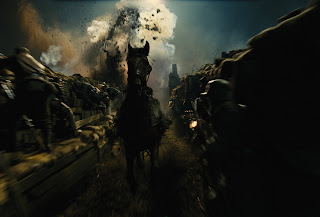
War Horse

Secondly, any opportunity to invite renowned author and academic Neil Sinyard to Dublin is a welcome one. Neil will give a talk at the IFI this Saturday at 3.10p.m., discussing Spielberg’s career to date with a particular emphasis on the titles screening in this season. His illustrated talk on Woody Allen was a highlight of last year’s IFI events, and Neil’s 1987 tome The Films of Steven Spielberg remains a seminal work, one we can only hope he plans to someday update. We’ll be cornering him on that one.

Jaws

Despite continued commercial success, Spielberg’s work has generated considerable derision over the last four decades. Critics in particular continue to take issue with his endeavors in ‘serious’ filmmaking and are already sharpening their knives in anticipation of next year’s biopic of Abraham Lincoln, currently filming with Daniel Day-Lewis in the title role. It often appears that he’s damned for his ambitions to flex his artistic muscles and doomed to disappoint admirers of his iconic ’70s and ’80s classics, when eagerly anticipated returns to popcorn moviemaking like Indiana Jones and the Kingdom of the Crystal Skull fall flat.

Raiders of the Lost Ark

At the same time, no other filmmaker casts as tall a shadow over modern cinema: Spielberg didn’t just create a body of work, he crafted a language — one winningly channeled by J.J. Abrams in his loving homage Super 8. As mogul and super-producer, he’s transformed the cinema beyond recognition, while retaining a boyish enthusiasm for a medium he still adores. When firing on all cylinders, and fully engaged by his source material, few filmmakers can conjure sheer cinematic magic like Spielberg still can. Longtime admirers revelled in his recent animated debut, Tintin: The Secret of the Unicorn, an unfairly maligned romp which culminated in an extraordinary — and gleefully extended — chase sequence that proved beyond question that he’s still got game.

Empire of the Sun

This iconic filmography still contains some unheralded gems, which is why we strongly recommend that you avail of the rare opportunity to catch 1987’s Empire of the Sun, presented at the IFI in glorious large-format 70mm. Featuring a stunning performance from a young Christian Bale — no other filmmaker directs children like Spielberg — this tale of a young boy’s coming of age in a Japanese Prisoner of War camp is a truly extraordinary and grown-up work, and to this day a sorely underappreciated one. Arguably, it’s Steven Spielberg’s masterpiece.

Derek O’Connor

For further details on the Steven Spielberg season, click HERE.

To celebrate the opening of War Horse at the IFI from Fri Jan 13th, we are delighted to offer a copy of the original novel on which the film is based to 5 lucky people! Simply vote for your favourite Spielberg movie in our Facebook poll before 11am on 13th Jan to be in with a chance of winning. Winners will be chosen at random after the poll closes. Courtesy of The Walt Disney Company, Ireland.


Friday, January 6, 2012

Silent Scores – Scores of Silents

The Artist isn’t the only silent masterpiece to screen in IFI this week. On Monday, January 9th we launch a new series of must-see cinema from the IFI Irish Film Archive with Come On Over  – an absolute cracker made in the original silent era in 1922.  


The film which we acquired recently from our friends at MoMA, New York, is a lively comedy about a young man who emigrates from a thatched cottage in the bucolic backwater of Lisdoonvarna to a rooming house in the bustling metroplis of New York leaving behind his beloved, Moyna, and his clay-pipe-smoking mother. Full of romantic misunderstanding and merry japes and peopled with society dames and drunks and smiling Irish cops, Come On Over features a brilliant cast of Irish and Irish American players including the dashing Ralph Graves, the indomitable ingénue Colleen Moore, and the wonderful comedienne Cork-born Kate Price. 


It’s a joy from start to finish, not least for the inter-titles written in a bizarre Oirish brogue. Some of my favourites include “But, Shane darlin’, you’re making me your widdy before you make me your wife!”; “It’s my little Moyna or her fetch – Only your voice is taller than it once was”; “It’s yourself that’s had the use of the May dew on her cheeks” and there’s lots more where those came from.

Adding to the entertainment and creating a live musical soundtrack will be the clever musical underscoring by pianist, Morgan Cooke and the lively jigs of piper Maitiú O Caiseide.

Sunniva O'Flynn
IFI Curator

All proceeds go to the IFI Irish Film Archive Preservation Fund
For more information on Monthly Must-See Cinema and Come on Over, please visit www.ifi.ie or call the IFI Box Office on 01-679 3477.

Tuesday, January 3, 2012

January at the IFI


Happy New Year and welcome to the start of the IFI’s 20th anniversary celebrations!

2012 is an exciting year for the IFI as we celebrate the 20th anniversary of the IFI the film centre and IFI Irish Film Archive being in Temple Bar. During that time the IFI has played a very important part in the lives of generations of film lovers and with the support of a very loyal audience, has grown to being one of Ireland’s busiest and most relevant cultural organisations. We look forward to celebrating 20 years of great film with you over the course of the year.

Come On Over

As part of our 20th anniversary celebrations we are starting a new monthly programme of great films from the IFI Irish Film Archive. We are beginning on January 9th with one of our newest acquisitions, Come on Over, a 1922 silent film that we have brought back to Ireland with the help of the Film Department of the Museum of Modern Art (MOMA) in New York. With live musical accompaniment this is not to be missed and all proceeds from the screening will go towards the IFI Irish Film Archive Preservation Fund.

War Horse

There must be few amongst us that haven’t been gripped at some point by Steven Spielberg’s extraordinary power as a story-teller. To mark the release of his new film War Horse, we are showing a small selection of his films, focusing on two of his recurrent themes: war and childhood. Spanning from Raiders of the Lost Ark to Schindler’s List, it is a great chance to see some old favourites on the big screen (and on 70mm) and to re-evaluate the work of one of the most successful and popular film directors of all time. Esteemed film critic and writer, Professor Neil Sinyard will be giving an illustrated lecture on January 14th about the extraordinary legacy of Spielberg’s career.

Steve McQueen and Michael Fassbender on the set of Shame

Steve McQueen made an extraordinary transition from film artist to feature director with Hunger in 2009 and his second film, Shame, fully delivers on all the promise of that debut. His collaboration with Michael Fassbender continues with another staggering performance by this very, very talented actor. The result is an extremely powerful and compelling film that will stay with you long after it finishes, if only for the mastery of the filmmaking. It opens on January 13th but there will be a special preview on January 10th with a live satellite Q&A with Steve McQueen.

The Artist

Michel Hazanavicius’ ‘silent’ film The Artist was the unexpected hit at Cannes in 2011 and has received a host of Golden Globe nominations and is being hotly tipped for a Best Picture nomination at the Academy Awards. It captures all the glamour, passion and drama of Hollywood’s silent era and offers respite from what may be a less than glamorous 2012!

It’s cold outside so what better place to be than in the cinema… so come along and lose yourself in these and some of the other wonderful films that we have screening this month!


Sarah Glennie
Director

For more information on the IFI Irish Film Archive Preservation Fund, please visit our website http://www.ifi.ie/support/donations/.


Friday, December 16, 2011

Film education - to the power of Ghibli

To almost quote a well-known UK retailer, never knowingly underestimate the potential of film to educate in a whole range of contexts. Here at IFI Education, we are fairly used to full houses of teens glued to subtitled films on weekday mornings, despite the conventional expectation that ‘young people won’t watch subtitles’. Yesterday, however, we had a fresh reminder of just how much a good film can engage a hugely diverse audience.


The Secret World of Arrietty, the latest film from the famed Japanese Studio Ghibli, was showing as part of our schools’ programme. The previous day, IFI Education’s Dee Quinlan and Elaine MacGinty looked after a full house of primary school pupils who watched and loved the dubbed version. Dee introduced the film, and talked a little about Japanese animation and how they might compare it with more familiar animation titles. Positive feedback gathered by Elaine afterwards ranged from the observant, ‘I loved the small details in the house’, to the surprising, ‘Humans and small people could connect’.


But it was the second screening that offered both a snapshot of film education and the potential of cinema itself. The largest group in the house were from an Irish language medium secondary school where students study Japanese. Their Japanese teacher introduced the film in Japanese and they watched the film to hear Japanese being spoken and experience Japanese film culture. A second group were from a deaf school, for whom the film was accessible as subtitled and their teacher signed Dee’s introduction in English. The other schools were Transition Year students watching for film studies. While not quite Babel, engagement with the film was through five different languages, with the initial connection being the audience’s literacy in the language of film itself. 


During our two-year research project, Film Focus, the results of which are due for publication in early Spring, we and the many film educators with whom we worked observed a whole host of ways in which film education is taking place around the country. We also were consistently reminded of the fact that the world for young people, irrespective of ability, is a visually mediated one and it’s the job of education to reflect that. That’s why access to a range of film is essential, be it through subtitling, providing readers, schools programmes, festivals, special events. We’re hoping for many more babel-esque experiences with schools’ audiences during the new term, even if they yield nothing more than one of yesterday’s feedback remarks, ‘I liked the happy ending’…

Alicia McGivern
Head of IFI Education

Visit our website for more information on IFI Education and IFI Schools Programme.
For booking or more information on IFI Education events, contact Dee Quinlan (t 01 679 5744, e: schools@irishfilm.ie).


Wednesday, December 14, 2011

The Horgan Projector

This 35mm cinema projector, which is displayed in the window of the Tiernan MacBride library, was donated to the IFI Irish Film Archive by Jim Horgan, Furbo, Co Galway, who is the grandson of James Horgan, photographer and shoemaker of Brown Street, Youghal, Co. Cork.


In the 1890s and 1900s, James and his brother Thomas Horgan toured Youghal and neighbouring towns and villages with a magic lantern slide and moving image show. They projected slides of local and foreign scenes, films from the Lumieré Brothers and local topicals - films they made themselves of local beauty spots and activities.

Such was the popularity of these film shows that in 1910 the Horgans began building Youghal’s first cinema. Seven years later, after considerable delays caused by the First World War, the Horgan Picture Palace opened in Friar Street on St Stephen’s night 1917.

The cinema seated 600 people with wooden benches to the front of the auditorium and more comfortable, upholstered seating to the rear. The walls of the auditorium and foyer were elaborately decorated with hand-painted scenes.
Variety shows at the cinema included slide presentations, newsreels, short silent dramas and sing-alongs, where the words of popular songs were projected on the screen. The projections were accompanied by the Horgan’s Picture Theatre Orchestra.

The Horgan's Picture Theatre Orchestra

A great attraction for the cinema audiences was the occasional screening of the Youghal Gazette, a newsreel featuring items of local interest produced by the Horgans for exhibition in their cinema. Items included: Corpus Christi processions, people leaving Sunday mass, the return of local men from Wormwood Scrubs prison in England (c. 1917) celebrations at the end of World War 1, outings to the sea and a series of clever photographic animations. These films have been transferred from the nitrate originals and are preserved at the IFI Irish Film Archive.

The Kamm projector was probably one of the two original machines installed for the opening of the cinema in 1917, but certainly dates from no later than the mid 1920s. It was adapted for screening sound films, possibly in 1929, when the Trial of May Dugan (dir. Bayard Veiller)- ‘an all talking picture’- was shown in the Picture Palace. The projector was powered by an electrical generator with a hand-crank built in for emergency use.


The Kalee lamp-house currently mounted on the machine is not the original one. It was not unusual to update the lamp-house as more powerful luminants became available. This Kalee model housed a carbon-arc lamp with a manually advanced arc-rod system mounted before an adjustable convex mirror.

The film reels were enclosed within heavy metal spool boxes which provided protection against fire from the highly flammable nitrate film stocks used commercially until the 1950s. The Kamm machine was somewhat unusual in that the take-up reel was housed within the lower body of the projector and not jutting away from the projector frame. The projector carried reels of no more than 2,000 ft approximately 20mins at sound speed. Feature length films were shown on two projectors with each projector showing alternate reels.

The cinema featured a back-projection system with projectors located behind the screen. The small space that was created between the projection box and the screen was used for some time as a bedroom. The cinema remained open until 1988. In 1996 the building reopened as a Heritage Craft Centre.

The IFI Tiernan MacBride Library  

This projector was meticulously restored by Bernard Matthews (Ardee, Co Louth) a member of the Projected Picture Trust. The Trust, registered in England, is committed to the preservation and exhibition of still and moving image equipment.

In addition to the magnificent projector, the IFI Irish Film Archive building also displays the camera on which the brothers shot their films and  the Archive holds a document collection relating to the administrative history of the Horgan Picture Palace and spanning the years 1917 -1956 collection. These include screenings diaries, gross and net takings records, accounts ledgers, logs of ticket sales, and carbon copied correspondence.

Sunniva O'Flynn
IFI Curator

Support the IFI Irish Film Archive Preservation Fund and donate today [here].

Tuesday, December 13, 2011

Ballymun Lullaby: community cinema


Frank Berry, director of Ballymun Lullaby shares his thoughts about the resurgence of community spirit in Ireland in recent years, and how he came to create this film. It is opening at the IFI on Friday December 16th and will run until the 22nd. The Ballymun Children’s Choir will sing Christmas carols in the IFI before the screenings on December 16th and 18th, and Frank will take part in a post-screening Q&A on 16th.


My work in the area of community video has been the most rewarding of all the work I’ve been involved in. I have directed probably more than 20 community projects, mainly for organisations with little money but in need of promotion. These local films would have big themes covering educational opportunities, personal development, disability and social disadvantage. I made one such community video for the Ballymun Music Programme in 2003 and when I returned to Ballymun in February 2009, I was struck by the changes in the area and the success of Ron Cooney’s work. Ron and I met for coffee and that’s how Ballymun Lullaby the film began.

Due to the film’s roots, I have been describing Ballymun Lullaby as a piece of community cinema. Many commentators have spoken about the return of community spirit in Ireland since the boom ended, how society is reconnecting with values that had become less important. This inspires me to find other stories that I believe are as important as this one. I believe Ron Cooney’s sincerity and vision gives us hope. 

And I know I won’t have to look far. Community cinema is all around us.

Frank Berry
Director

For more information and bookings, visit our website or call on 01 679 3477.

Friday, December 2, 2011

Sharing European cinematographic heritage


The popularity of content sharing websites like YouTube has led to an expectation from the general public that moving image archives should be able to make all their holdings available on-line. A reasonable expectation you might think, but making material available in this way is much more difficult than most casual viewers might imagine. 

Once Upon a Tram

Like many moving image archives, the IFI Irish Film Archive does not own the rights for 99.9 % of the material is holds, so must seek permission from the copy right owners of each piece of footage it wants to make available to the public on a case-by-case basis. In addition to the resource implications of this process, rights holders are understandably wary of their personal collections being available in a manner over which they have no control, and of course the misappropriation and reuse of material without the owners’ permission is another big concern. As archivists we have to try and find a balance between making the collections we hold widely available to the public and protecting the rights and goodwill of the people who have entrusted their films into our care.

In recent years the IFI Irish Film Archive has published a number of DVDs with the aim of bringing our collections to a wider audience and we also recently began to work with the Europa FilmTreasures project which encourages European citizens to discover their shared European cinematographic heritage.  The project is the brain-child of Serge Bromberg, founder of Paris-based Lobster Films. Serge had long been aware of the meticulous work being undertaken by film archives throughout Europe and of the difficulties that existed in making this work available to a wider public. He felt that an online project that respected the rights of the copyright holders and used anti-copying and anti-downloading security measures, would give film archives a democratic way to highlight their collections in an international context.

Once Upon a Tram

The IFI Irish Film Archive currently has 4 titles available to watch on the site, with more being added all the time. Each film is translated into French, German, Italian and Spanish to ensure it is accessible to as many European citizens as possible.  Our most popular film is Once Upon a Tram (1959) which to date has received over 20,000 viewings. Produced by Leinster Studios, Once Upon a Tram looks at one of the last journeys of the Howth Tram and is a record of an elegant and leisurely form of transport of a by-gone era. The film was made with the realisation that trams were about to become a thing of the past in Dublin, with the opening scenes of the film featuring shots of tram lines in Dublin’s city centre being dug up. Once Upon  A Tram focuses on the different people who make use of this mode of transport and is narrated by Cyril Cusack.

Also on view on the EFT website are Voyage to Recovery (1953) and  Tony Bacillus and Co (1943) These films were part of a series of educational and public information films made by the National Film Institute (now the IFI) in the 1940s and 1950s on behalf of the department of Health.

Voyage To Recovery

Voyageto Recovery aimed to demystify and de-stigmatise TB and its treatment.  It features Brian (Joe Lynch) a middle class family man and loving husband, who is undergoing treatment and convalescence in one of the government’s modern and well equipped TB sanatoriums. By refusing to be ashamed of his illness, Brian addresses the prejudices that existed in the public consciousness at that time regarding the disease. The film subtly reassures the public that the government was dealing with the problem of TB in an effective manner.

Tony Bacillus & Co

The second title Tony Bacillus & Co (1946) is a comical public information film about the threat of tuberculosis in which TB is represented by a menacing puppet, who attempts to infect a little boy puppet by placing various hazards - spitting, coughing and drinking unpasteurised milk - in his path. However, the boy puppet is well versed in disease prevention and T. Bacillus is foiled. Last year this film was chosen by the Europa Film Treasures project to have a score written by Anaïs-Gaëll Lozac'h and recorded by the prestigious Paris Conservatoire, and this addition greatly enhances the viewer’s enjoyment of the film.

Ciall Cheannaigh

Our latest addition to the project Ciall Cheannaigh (1969) is a delightful and quirky film made by Guinness brewery employee Mike Lawlor as part of the company’s Film Club, and takes a humorous look at the then recent phenomenon of shopping centres in Ireland. Showing the hustle and bustle of shoppers in Dunnes Stores in Cornelscourt, the film accurately captures burgeoning consumer society and is a charming portrait of Irish suburban life in the late 1960s.  On the look-out for bargains are a motley group of shoppers ranging from a priest and his housekeeper, grocery-shopping young couples, lingerie-buying ladies and children of all ages. The excitement of this new shopping experience is further conveyed by a frenetic soundtrack by renowned traditional Irish musician Dónal Lunny.

To see the films mentioned above visit the EFT website and we will let you know of any new additions to the project.


Kasandra O'Connell
Head of IFI Irish Film Archive

Support the IFI Irish Film Archive Preservation Fund - for more information and how to donate, visit  www.ifi.ie/preservationfund

For more information on IFI Irish Film Archive DVDs, visit IFI Film Shop or follow @IFI_FilmShop on Twitter.