Thursday, May 22, 2014

To coincide with the presentation of States of Fear to mark its 15th anniversary, the Tiernan MacBride Library looks at other documentaries which caused controversy in Ireland

Shocking Documentaries: Four Films that Sparked Outrage in Ireland

This month the Mary Raftery Journalism Fund, in association with the IFI and RTÉ, marks the 15th anniversary of the broadcast of the States of Fear documentaries with screenings and discussions examining the impact of the series on Saturday, May 24th. Mary Raftery’s exposure of the abuse and neglect practised in Ireland’s industrial schools caused a public outcry, pressuring the Irish Government to apologise for its role in perpetuating the system.

We in the IFI Irish Film Archive’s Tiernan MacBride library look at other documentaries which, for varying reasons, caused outrage in Ireland.

1. Ireland: The Tear and the Smile (1961)
This CBS documentary, examining contemporary Ireland, was broadcast to American audiences in 1961. Initially the Irish Government collaborated with the filmmakers, recognising the potential of the programme to transmit images of a thriving modern Ireland to potential investors in the U.S. The finished programme angered the State who believed it reinforced offensive stereotypes of Ireland as a poverty-stricken, primitive country decimated by unemployment and emigration. Sean Lemass maintained that his government had been grossly deceived by CBS but his letter of protest was sharply dismissed by the programme’s producer, “for us to pretend these situations did not exist would be journalistically dishonest.”  [1]

Walter Cronkite in Ireland: The Tear and the Smile observes the Irish in “two of their favourite occupations, ‘talking and drinking'.” [2] Copyright 1961 Robert Monks

2. Open Port (1968) 
The Radharc team of priests produced programmes that examined moral and social issues within a religious context. In Open Port their documentation of alleged prostitution along the quays in Cork City drew censure because of their use of a hidden camera to film young girls boarding ships with sailors. The documentary sparked a media debate that ran for months; critics accused the team of infringing upon the subjects’ human rights to produce a sensationalist story, while supporters commended Radharc’s high journalistic standards and its unflinching exposure of a “social evil.” [3]

Fr. Leo Lennon, port Chaplain, calls for the closure of Cork’s quayside in Open Port.
Copyright 1968 The Radharc Trust

3. Fairytale of Kathmandu (2007)
Nessa Ní Chaináin’s second documentary about the poet Cathal Ó Searcaigh began as a tribute to his work establishing education projects in Nepal. Her unease about the poet’s sexual relationships with several of the Nepalese youths he supported changed the focus of the film, however. Ó Searcaigh asserted that these were consensual relationships conducted with men above the Nepalese age of consent and accused Ní Chianáin of betraying his trust. She was concerned with the “disparity of power” [4] involved in the relationships between a 50-year-old wealthy westerner and poor 16- to 17-year-old Nepalese boys. The divisive film brewed up a media storm in Ireland but a subsequent Garda investigation resulted in no official charges being made against Ó Searcaigh. 

Cathal Ó Searcaigh is welcomed to Nepal in Ní Chianáin’s first documentary about his work in The Poet, The Shopkeeper and Babu. Copyright 2006 Vinegar Hill Productions


4. The Pipe (2008)
This film chronicled the resistance of a local Mayo community to Shell Oil’s government-backed plans to lay a gas pipeline through Rossport. Risteárd Ó Domhnaill was concerned that Shell was manipulating the news to criminalise protestors and wished to give a voice to “respectable people being treated as if they were thugs.” [5] Though criticised in some quarters for its perceived lack of objectivity, the documentary captured shocking scenes of violence used by Gardaí in clashes with protestors, which bolstered support for the community’s struggle.

Gardai baton-charge protestors in The Pipe. Copyright 2010 Underground Films


By Eilís Ní Raghallaigh

The IFI Irish Film Archive’s clippings and document collections contain thousands of files and images relating to all aspects of Irish and Irish-interest film and television production. They are available to view in the Tiernan MacBride library within library opening hours, or by appointment with the librarian. Please contact the IFI librarian, Fiona Rigney, for more information. 

[1] Savage, R. J. (2003) Ireland in the New Century. Dublin: Four Courts Press.
[2] Savage, R.J. (1999) Ireland: The Tear and the Smile. In L. Dodd (Ed.), Nationalism Visions and Revisions (pp. 60-63). Dublin: FII Publishing, 1999. 60-63.
[3] Realist. (1969, January 1). Cork Quays. Cork Evening Echo.
[4] Sheridan, K. (1996, February 2). Sex, power and videotape. The Irish Times, pp.3.

[5] Clarke, D. (2010) Almost by accident, he was making a documentary… The Irish Times, pp. 9.


http://www.ifi.ie/statesoffear

Tuesday, April 29, 2014

Not Just in Black and White – 5 Complex Irish Clergymen from Film History as chosen by the IFI Irish Film Archive's Tiernan MacBride Library.

John Michael McDonagh’s film, Calvary, currently showing in the IFI, is garnering rave reviews and enjoying phenomenal success at the Irish box office. Brendan Gleeson’s dedication of his performance to “Ireland’s good priests” [1] has inspired us in the IFI Irish Film Archive’s Tiernan MacBride library to look back on some of the most powerful film depictions of 'good' Irish priests. Here, sourced from material in our clippings and image archives, we count down our top 5 list of films depicting well-intentioned, but humanly flawed Irish priests. 

Brendan Gleeson in Calvary. Copyight 2013 Octagon Films

5. LAMB (1985) 
At number 5 is Liam Neeson’s role as Brother Sebastian, a young priest who flees the oppressive fear and violence in an Irish clergy-run borstal for London with a bullied, epileptic student. His act of defiance against the Church and his attempt to save the boy’s life ultimately end in tragedy. When reading Bernard McLaverty’s book on which the film was based, Neeson felt, “that’s my part, if I had to kill to get it.” [2]

Liam Neeson and Hugh O'Conor in Lamb. Copyright 1986 FilmFour

4. THE BISHOP’S STORY (1994) 
Donal McCann portrays a bishop who recounts how, as an idealistic but lonely priest, he fathered a child with a young woman. He confesses his affair to his congregation, hoping his honesty will allow him to remain with them as their pastor and care for his lover and child. When his gambit fails he loses his faith and retreats to the foreign missions. Despite his transgressions he is eventually promoted to the position of bishop saying bitterly, “When they can’t sack you, they promote you.” [3] 

Donal McCann in The Bishop's Story. Copyright 1994 Cinegael

3. RYAN’S DAUGHTER (1970) 
Trevor Howard plays the formidable, rigidly moral Father Collins, who is priest, social worker, mediator and marriage counsellor to his parishioners. His faith, however, does not preclude his Republican leanings. Alec Guinness, a Roman Catholic, turned down the role because of objections he had to the portrayal of the priest as a “gruff old curmudgeon.” [4] David Lean was later to rate Howard’s performance as his personal favourite in the film. [5]

Trevor Howard in Ryan's Daughter. Copyright 1970 Courtesy of BFI

2. GOING MY WAY (1944) 
Barry Fitzgerald was nominated as both Best Actor and Best Supporting Actor for his role as Father Fitzgibbon, and won for the latter. [6] As Father Fitzgibbon, his traditional beliefs clash with those of the younger Father O’ Malley, played by Bing Crosby. They are reconciled by the film’s end when their church is saved from its financial woes, the parish’s troubled youths have formed a successful choir and Father O’ Malley has re-united Father Fitzgibbon with his 90 year old Irish mother -now that’s what I call a Hollywood ending.

Barry Fitzgerald in The Quiet Man. Copyright 1952 Connacht Tribune

1. STELLA DAYS (2011) 
Martin Sheen plays Father Daniel Barry, a parish priest who faces opposition from his fellow clergymen, local political forces and parishioners when he sets up the Stella Cinema in 1956 to raise Church funds. He is a conflicted character who is outwardly caring and committed to the Church, but who struggles internally with his vocation, feels a sense of superiority to his parishioners and resents his rejection for a position in the Vatican. Stella Days was filmed in Borrisokane, where Sheen’s mother was born. [7]

Martin Sheen in Stella Days. Copyright 2011 Newgrange Pictures

By Eilís Ní Raghallaigh

The IFI Irish Film Archive’s clippings and document collections contain thousands of files and images relating to all aspects of Irish and Irish-interest film and television production. They are available to view in the Tiernan MacBride library within library opening hours, or by appointment with the librarian. Please contact the IFI librarian, Fiona Rigney, for more information. 

[1] Scally, D. (2014) ‘Gleeson dedicates film role to Ireland’s ‘good’ priests’ , The Irish Times, 10 February. Available here.
[2] Kennedy, M. (1985) ‘Lambs to the Slaughter’ ,  The Irish Times, 28 May, pg. 12.
[3] O’Shea, S. (1995) ‘The Bishop’s Story’ , Weekly Variety, 24-30 May
[4] & [5] Phillips, G.D. (1996) Beyond the Epic: The Life and Times of David Lean. Lexington: University Press of Kentucky. 
[6] W, K. (2003) ’75 Years of the Oscars Part One: Going My Way’ , A Sunday Times Special Supplement, 9 February. 
[7]Shortall, E. (2010) ‘Movie brings Hollywood Sheen to North Tipperary’ , The Sunday Times, 15 August. 


Tuesday, April 1, 2014

IFI Librarian Fiona Rigney highlights some additional resources about filmmaking available at the IFI Library

Ahead of IFI Spotlight, our annual focus on film and television made in or about Ireland, IFI Librarian Fiona Rigney picks her top 3 new books about filmmaking now available at the Irish Film Archive and Library.

IFI Spotlight is taking place throughout April with key new Irish film releases and culminates in a day of free seminars and panel discussions at the IFI on Saturday, April 12th. If you are a film student, researcher, academic, filmmaker or simply just interested in the industry, the IFI Tiernan MacBride Library is home to the largest collection of film related publications in the country and is open to all.

Here are some of Fiona's recommended reads (and there are plenty more in the library!):

1. How to Write Great Screenplays and Get Them into Production by Linda M James
This book teaches you all you need to know about how to succeed in writing and making your own screenplay. With great tips and practical advice, this is a must-read for any budding screenwriters and filmmakers.


2. Introduction to Film Studies 5th Edition Edited by Jill Nelmes
This is one of the best core textbooks for anyone studying films or for anybody who would just like to gain an insight into the film industry. This completely revised and updated fifth edition guides you through the key issues and concepts in film studies, traces the historical development of film and introduces some of the world’s key national cinemas.


3. The Technique of Film and Video Editing: History, Theory, and Practice, 5th Ed. By Ken Dancyger
This book contains the best training for aspiring directors and editors and gives a detailed look at the principles and practices of editing for both picture and sound. 


To have a look at these or any of our books, press clippings collection and film journals; call into the IFI Tiernan MacBride Library (located in the Archive Building, at the back of the main IFI building).

The library has over 3,000 books, over 150 different film journal series and over 5,000 press clippings files. The Paper Archive consists of production notes, scripts, storyboards, correspondence, publicity, ephemera, stills and posters, and includes collections from filmmakers such as Neil Jordan, Jim Sheridan, Donald Taylor Black, Pat Murphy, Lord Killanin and Josie MacAvin. It also holds a vast collection of material from the Irish Film Board and the Broadcasting Authority of Ireland.  

For more information on our extensive Paper Collections Archive please check out the website or contact the Librarian/Document Archivist, Fiona Rigney.

Opening hours:   
Monday: 2.00pm-5.30pm
Tuesday: 10.30am-1pm and 2pm-5.30pm
Wednesday: 10.30am-1pm and 2pm-5.30pm
Thursday: 2.00pm-5.30pm
Friday: closed

Library Charges:                                             
Students €1.50 per visit; general public €2.00 per visit.                                     

Annual Library Membership:
Students €15.00 per year; general public €20.00 per year


Monday, March 24, 2014

Jury Critic Brogen Hayes on why three young actresses stood out in We Are The Best!

The journey from child to teenager is a path that rarely runs smooth; as we change, our relationships with friends, family and the world around us changes too. The journey is often observed in cinema, but rarely with such sincerity and warmth than in Lukas Moodysson’s upcoming film, We are the Best! (Vi är bäst!)  which previews as part of the IFI's Rock' n 'Roll season Saturday 29th March at 18.30 and is released on 18th April.


The film follows three young girls, Bobo (Mira Barkhammar) and Klara (Mira Grosin), who are best friends, in the way that only pre-teen girls can be. The performances of the three lead actresses depend on one another in a truly remarkable way; the chemistry between the three is wonderful and they allow the power to shift between them, leaving room for jealousies, arguments and ultimately, resolutions. The struggle that each of the characters goes through in their family lives is utterly relatable. That said, however, We are the Best is ultimately an uplifting film about the delirium of childhood and the joy of finding good friends.


In the end, it is the chemistry between the three young actresses that carries the film; it is also the reason that audiences will fall in love with the film and the journey these girls go on. It is hard to imagine the film working as well without the strong ensemble performance at its heart, so when considering the film as part of the Jameson Dublin International Film Festival jury, we finally decided to jointly award Best Actress to Barkhammar, Grosin and LeMoyne.


We are the Best! is a careful and precise observation of the journey between childhood and adolescence, and the friends who last us a lifetime. Barkhammar, Grosin and LeMoyne are wonderful in their roles, and utterly support one another. In the end, We are the Best! is charming, warm and a whole lot of fun.

Brogen Hayes, Deputy Editor of Movies.ie and Jury Member of Dublin Film Critic's Circle 2014

Thursday, March 13, 2014

Experimental Film Club presents 'The Train, The Cinema'

"Suddenly something clicks, everything vanishes and a train appears on the screen. It speeds straight at you—watch out!" The perceptual experience of train travel offered several parallels to the cinema experience, and both will be discussed as part of this month's Experimental Film Club selection.

In a recent exchange between experimental filmmakers Rouzbeh Rashidi and Maximilian LeCain, Le Cain outlined the degree to which he now feels out of sync with a 21st century moving image culture. Le Cain continued to be engaged instead with what he describes as a “very 19th century sense” of image culture; of the train approaching the station and the original sensation of “cinema as miracle”. Le Cain is referencing here the Lumiere’s film Train Arriving at La Ciotat one of the most well known, and frequently revisited scenes in cinema history. Many point to this as the key formative moment for the cinema, what Tom Gunning refers to as its ‘primal myth’, alluding not just to the film itself but to the frequently-cited image described in relation to early audiences and their extreme reactions to the film. This image of audience members who became so excited by the image of this approaching train that they either hid under their chairs or ran screaming from the room has by now become all too familiar. It provides us with a suitable distance for our more removed relationship to the screen, to the moving-image, and to the naiveté of those audiences. Re-watching this film now we are unlikely to experience these same hysterical reactions, less likely to confuse an onscreen reality with our own everyday perpetual reality. This distance between our current relationship with the screen, and with cinema and the moving image, and the image of those first audiences experiencing a mechanised moving-image for the first time is striking, but, as is too often the case, there may be more to it than we think. 


Gunning outlines that scene as the first of many myths that would spring up around the cinema throughout its history. As he acknowledges it is a scene that may never have actually even taken place, at least not in the manner it is typically described. Early accounts are hard to verify and the film is not believed to have appeared among the Lumiere’s very first screenings, Workers Leaving The Factory is instead the film more typically cited as the first. As Gunning acknowledges however this has done little to reduce the power or the longevity of this mythic image, an image that gets to the heart of many of cinema’s potentials and possibilities. In a famous essay entitled The Kingdom of Shadows Maxim Gorky offered his own impressions of the scene: 

"Suddenly something clicks, everything vanishes and a train appears on the screen. It speeds straight at you—watch out! It seems as though it will plunge into the darkness in which you sit, turning you into a ripped sack full of lacerated flesh and splintered bones, and crushing into dust and into broken fragments this hall and this building, so full of women, wine, music and vice." 


Gorky’s quote captures a lot of the early anxieties that existed in relation to the cinema. Often considered a den of iniquity the cinema was initially considered only to appeal to the basest of instincts, it blurred class distinctions, it catered to an unedecated and unrefined crowd and its darkened rooms seemed to invite and suggest all kinds of illicit behaviour. The cinema was dangerous, it suggested a real and considerable threat to civil society and to the psyches of those that experienced it. Early accounts of the cinema’s impact were equal in their hysteria to those that sprung up around the Lumiere’s Arrival film, describing a profound and disruptive impact these experiences were likely to have on an impressionable, corruptible populace. In spite of the questionable veracity of these accounts the distance between our current relationship with the screen and the experiences of early audiences would seem all too clear. In these early reports the cinema appeared ‘suddenly’ at the turn of the 20th Century as a potentially revolutionary force, an untameable machine and for some time to come this would remain as both the promise and the threat of cinema. 

For the cinema to thrive this perceived threat and potential would have to be reduced, diminished, domesticated. For its more mainstream iterations, some of these rougher edges, and for some much of its potential, would be reduced and managed. This cinema experience began to strive for invisibility, attempting to create a closed, secure world which its audiences could inhabit safely. Any techniques that disrupted this immersive illusion, that reminded audiences that they were watching a film were reduced, made ‘invisible’, in favour of a narrative form which audiences could lose themselves in for a set period of time. This was a cinematic impression of reality that carefully mirrored our own perceptions of reality and with these changes in place the cinema could become a more pervasive force. It became inescapable and it would help shape how the twentieth century was experienced. This was of course however only one cinema, only one potential direction taken and an avant-garde also emerged as a possible corrective to this more general tendency and a reminder of some of cinema’s still uninhabited possibilities.

The Lumieres had succinctly grasped many of the key potentialites of the moving-image at the moment when they placed their camera to the right of an approaching train in the small French town of La Ciotat. Their framing of this machine captured the breath of cinema’s depth, and exploited a variety of exciting possibilities for foreground/background juxtaposition. Audiences immediately recognised themselves in the passengers they saw on the platform and alighting from the train. More than this however the cinema in its looking at a train had found a way, at this early stage, to look at itself. The train had become the perfect on screen stand-in for the cinema and its processes, mechanical and otherwise, making visible what was often felt as an invisible presence. The train could now serve as a reflexive device for the cinema, a means for reflective self-examination. The cinema then, and throughout its varied histories, would return to this scene repeatedly.  

Terence Davies’ The House of Mirth  


Victor Erice’s The Spirit of the Beehive

Peter Tscherkattsky’s L’Arivee   

The perceptual experience of train travel in the 19th century offered several parallels to the cinema experience, an all too similar uncanny combining of movement and stillness that mirrored the mechanics of film. A steady rhythmic flickering of objects passing too close to a window that stood in for the flicker of the screen, especially in those early days. An invisible turning of cogs and wheels that mirrored the cinema’s own, rarely visible, cogs and wheels and the views from a train, which upon entering a tunnel for example, could suddenly shift from window to mirror, providing another essential analogy for on the one hand cinema’s immersive/realist capacity and the reflexive/reflective functions favoured by an emergent avant-garde. 

Henri Chomette Jeux des Reflets et de la Vitesse

Cinema history should never be conceived of as a straight line, it should instead be thought of a plurality and it is full of divergent paths and roads not taken, its progress was never predetermined. All of its histories sit on top of each other and intersect in unexpected and surprising ways, and the cinema’s forgotten pathways are frequently rediscovered and unearthed. The train provided the cinema with a subject and a means through which it could explore some of these divergent possibilities and the films included in this programme present a number of potentialities in this regard. Stan Brakhage’s Wonder Ring, a film full of reflective surfaces which subtly warp and alter our perception, was also an important document of impending obsolescence, recording a path through the city by a Third Avenue elevated train that was soon to be destroyed. Tscherkassky’s ‘found-footage’ film L’Arivee returns us directly to the Lumiere’s origin point, only here everything is visible, the scratches, pops and stabs of celluloid, even the ‘track’ along the side of the celluloid strip, an aspect of the film machine designed to only ever be heard and not seen. Eventually, after various manufactured collisions, the film jumps to a close-up and suddenly from the film (the medium) and the train (the machine) emerges Catherine Deneuve (‘the star’). 

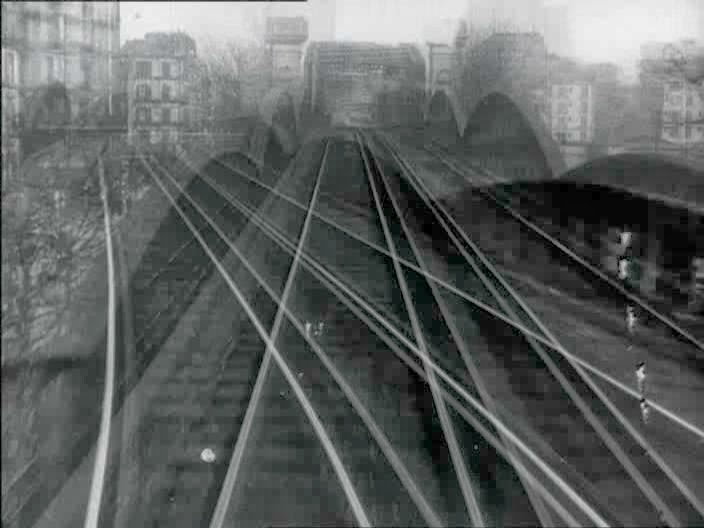
Henri Chommette’s Jeux des Reflets et de la Vitesse (Games of Reflection and of Speed) also plays with reflective surfaces and superimposition, only here we are placed in the subjective position of the train, just as we were in the early ‘phantom ride’ films, we no longer watch the train we are the train, we internalise its processes. Chomette described it as a ‘pure cinema’, not images for images sake and a variety of techniques and operations are on display here, double exposure, negative printing, accelerated speeds, resulting in a ‘cinema of sensation’, freed from any of the bounds of representation. 

Ken Jacobs takes us on a similar journey working with a 1906 film and using an optical printer and split screen processes to disrupt and undermine any normative sense of space and time we might still retain. Donal O'Ceilleachair’s ‘single-frame’ film returns us to Oscar Fischinger’s ‘city symphony’ films collapsing a journey from Istanbul to Berlin, fourteen days, down to three breath-taking minutes. Finally Pip Chodorov with Faux Movements creates a sense of motion, of moving through space through what are often unexpected means, yet another ‘phantom ride’.   

This programme of films is the third to consider the train, others included James Benning’s farewell to the filmic medium RR and Sarah Turner’s attempt to update the train film for the digital age Perestroika. As Maximilian Le Cain’s comments acknowledge the train seemed to tie the cinema to a set of concerns inherited from the 19th Century. The degree to which these concerns can remain central to the moving-image culture of the twentieth century remains to be seen. There are also several other obsolescences on display here, most visibly that of the medium itself. The correlations between train and film outlined in these films and elsewhere will not necessarily continue into an age dominated by the digital image. In Tom Gunning’s essay on that early Lumiere screening of a train’s Arrival he reminds that early audiences were likely far more aware of what they were experiencing than we care to admit. These audiences were not astounded and astonished by the train that was apparently about to burst through the wall and tear them asunder, in fact it was something far more remarkable. These early audiences remained fully aware that what they were watching was ‘cinema’, early screenings often began with a still projected photographic image, an image which slowly burst into life, introducing moving-image, movement and animation, were there had previously only been stasis. It was all the possibilities that this image/these images contained that filled these audiences with awe and wonder, as hard as it may be for us to now grasp this was in and of itself enough and it is this distance that we might now sharpen ourselves to in comparing ourselves to those early audiences, to think otherwise would present us as the only naïve participants within this exchange. 

Daniel Fitzpatrick
Experimental Film Club

The Train, The Cinema is this month's presentation of the IFI & Experimental Film Club, and will screen on Wednesday, March 19th at 18.30. Tickets now on sale - BOOK NOW.

Wednesday, February 26, 2014

Adrian Wootton explains the background to his upcoming illustrated talk, The Rolling Stones on Screen 1963 - 2012, on March 4th

The Rolling Stones’ fame (some would say notoriety) and enduring popularity for 50+ years is inextricably linked, not just to releasing records and live performance but to their appearances on television and film. Just like the Beatles, the Stones capitalised on burgeoning opportunities of TV exposure in the UK and the US and honed their image and stage personae, not just in front of live audiences but within the context of television studios. 

The Rolling Stones on ABC in 1964 (by Terry O'Neill)

They also rapidly saw the potential of film to give them even greater exposure, although their more outlaw, maverick identity pushed them towards documentary and art movie, rather than the musical entertainment vehicles initially developed by, for example, the Beatles. This means that the story of the Stones on celluloid is fascinating, idiosyncratic and unsurprisingly, often controversial.

Gimme Shelter (1970)

As a huge admirer of the band and intrigued by their forays into both small and large screen, I want to trace that history to explore the stories behind the legendary appearances on things like The Ed Sullivan Show and the quirky and often shocking revelations given in films like Godard’s Sympathy for the Devil and the Mayles Brothers' Gimme Shelter. Thus, my talk whilst working through a chronological filmography, also describes the sometimes extraordinary circumstances of the different conditions that films got made (partly based on research and partly on conversations I have had with some of the people involved) and also hopefully reveals how the Stones were changed by how they were depicted on screen. 

Sympathy for the Devil (1968)

Nevertheless, the talk is both an exploration and a homage, with a plethora of clips and images that reaffirms just how great 'the Greatest Rock 'n' Roll Band in the World' can truly be.

Adrian Wootton
Chief Executive 
Film London and the British Film Commission

The Afternoon Talk, The Rolling Stones on Screen 1963 - 2012, will take place on Tuesday, March 4th at 16.00. Tickets €5 (on sale now).

Jean-Luc Godard's Sympathy for the Devil will screen directly after the Talk, at 18.30, as part of the IFI's Rock 'n' Roll season in March. Tickets are on sale now.